Offers
 Account
 Menu
Menu Favorite
 Basket



 Need Optical Advice?







 Updated on:
16 June, 2026
Updated on:
16 June, 2026


 Copy Link


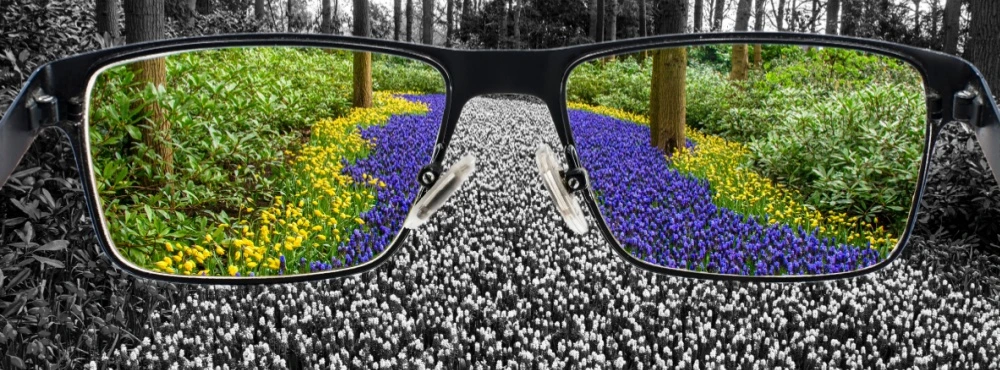
One of the rarest forms of colour vision deficiencies (CVDs), tritanopia is a type of colour blindness that makes it difficult for people to distinguish primarily between blue and yellow. This is why it’s also commonly known as blue-yellow colour blindness. It can also affect other colours that contain shades of blue and yellow.
Unlike red-green colour blindness that mainly affects men, tritanopia affects both men and women equally. It is often misunderstood and confused with other types of colour vision deficiencies. This article answers all your questions about tritanopia, including what it is, how it is caused, its symptoms and possible treatment options.
- What is tritanopia and how is it caused?
- Tritanopia symptoms
- Living with Tritanopia and its treatment
What is tritanopia and how is it caused?
Krina Halai, a Dispensing Optician at Feel Good Contacts, explains, “Colour vision deficiency occurs when one or more cone cells in the retina are dysfunctional, missing or altered.”
Our eyes contain three types of cone cells, found in the retina, each sensitive to a different wavelength of light. This includes the short wavelength (denoted by s cones) that is sensitive to violet and blue light, the medium wavelength (denoted by m cones) that is sensitive to green light and the long wavelength (denoted by l cones) that is sensitive to yellow and red light.
There are two forms of blue-yellow colour blindness (also called Tritan defects):
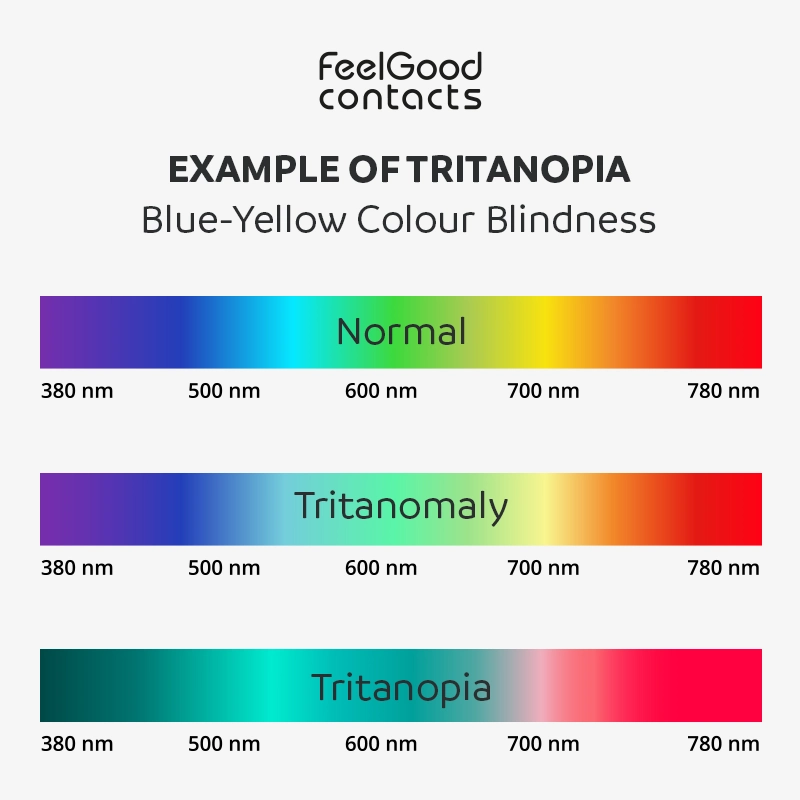
- One is tritanopia, the more severe form, in which the s cones are non-functional or absent, resulting in a complete loss of the blue and yellow colour perception. This means that, unlike a normal eye, the eye with tritanopia is unable to process short light wavelengths, making it difficult to perceive the blue-yellow colour axis.
- The other is Tritanomaly, a partial dysfunction, in which the s cones are present but defective due to a gene mutation. People with tritanomaly can identify some differences between blue and yellow, but their perception is inaccurate.
These colour blindness types are also called dichromacy or dichromatism, in which only two cone types are functional instead of three. People with tritanopia, also known as dichromats, have an altered colour vision palette. Blue may appear greenish to them, while yellow may appear violet or pinkish, whereas other colours that are partially blue or yellow may also be difficult to perceive.
Tritanopia symptoms
Tritanopia symptoms can vary as per its type and severity. Most commonly it affects the ability to distinguish between certain colours. However, People with tritanopia might also find blue and yellow colours less bright. In severe cases, some people might also experience light sensitivity and quick side-to-side eye movements.
This colour blindness can make everyday tasks difficult, such as selecting matching clothes and reading traffic or warning lights when driving. It can also make some occupations restrictive or inaccessible, such as pilots, police force, interior design or graphic design.
Living with tritanopia and its treatment
Currently, there is no cure for tritanopia, as the s cones cannot be restored. However, people with this condition can live normal lives. Some of the ways to manage blue-yellow colour blindness are as follows:
1. Colour-filtering lenses
Special tinted or colourblind glasses, especially with red or rose tints, can alter the blue and yellow colour spectrum to some extent. This helps distinguish these colours, improve contrast and view the world more vividly.
These glasses are made from optical materials that filter specific wavelengths of light. Available in both prescription and non-prescription options, these eyeglasses look a bit like sunglasses. However, they don’t work for everyone and even if they do, the results are quite low.
2. Digital accessibility tools
Most operating systems, such as Windows, macOS, Android and iOS, offer colour vision accessibility modes that let you adjust display colours, including blue and yellow. There are also browser extensions, particularly designed for colour blind people, to help them clearly view images on websites in different colours.
Moreover, there are some colour identification mobile applications that use the phone camera to detect and name colours aloud, helping people distinguish between different colours when required.
3. Labelling
People with colour vision deficiencies can organise their personal items by labelling them. This includes labelling coloured objects used in everyday life (like clothes and cables) with text labels, shapes or patterns with the assistance of a family member or friend. This way, people with colour vision deficiencies can easily recognise whatever item they are looking for.
4. Better designs
More designs are now becoming accessible for colour blind people. Apart from colours, the designs use other elements as well to convey information, such as symbols, patterns and text.
Like other forms of colour vision deficiencies, tritanopia isn’t a serious vision issue. Although a person with blue-yellow colour blindness may confuse blue and yellow, it does not affect vision sharpness or clarity. With some lifestyle adjustments, living with tritanopia can become easier and more manageable, just like living without colour blindness.